In Ted Lasso, Dani Rojas (a striker from Guadalajara, Mexico..) says “football is life” while grinning like a man who has never lost anything. I’ve lost plenty, and I still mean it. I support a club that has been shit for over a decade, I got my lessons on the hungarian terraces and I’ve spent years standing in stadiums on four continents where sometimes I couldn’t read the banners.
You don’t pick a club for its results
I was five when Manchester United became mine. A five-year-old doesn’t choose a club on merit, he chooses it because of a shirt, a name, a moment. What I got in return was a lesson in loyalty before I understood the word. Since Sir Alex Ferguson retired, United have been a long, expensive disappointment: owners who know fuck all about football, managers who arrived with big plans and left with nothing, signings that never made sense and a club that forgot what it was. Plenty of people left and I understand why, but supporting a club isn’t a subscription you cancel when the service gets worse. Anyone can love a team that wins, being loyal costs you something and the cost is what makes it mean anything.
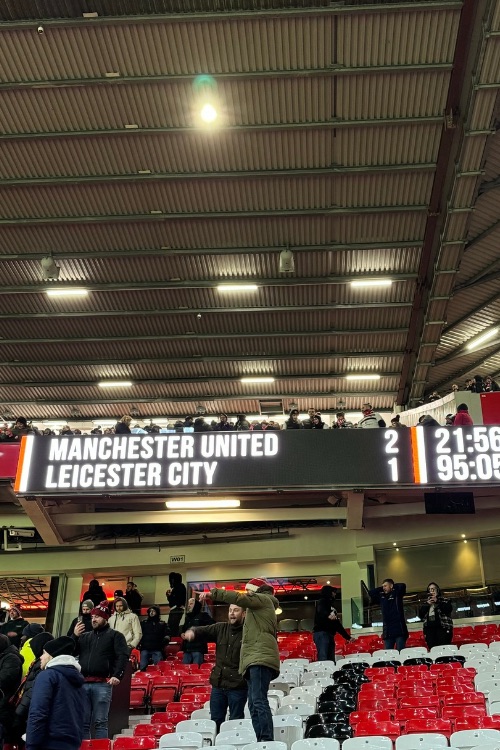
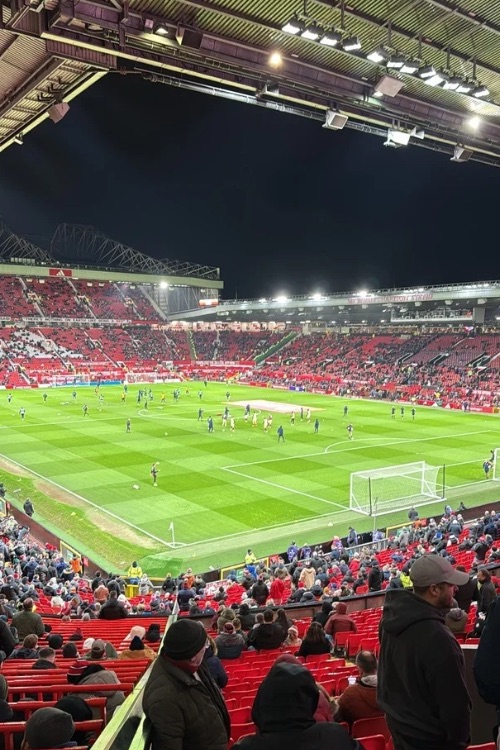
Old Trafford, 7 February 2025
My one time at Old Trafford was United against Leicester in the FA Cup. Shitty, cold and rainy weather, real England. I’d watched that stadium on screens for more than twenty-five years, and what surprised me wasn’t the size. It was how familiar it felt, like walking into a house I’d seen in photos my whole life. The team on the pitch was a shadow of the one I grew up idolising and it didn’t matter. I wasn’t there for the football, I was there because it’s my club and I was finally standing in its house. Walking up to the ground, it didn’t feel real. For twenty-five years Old Trafford had been a place on a screen, and now my feet were actually on the concrete outside it. I kept expecting to wake up. Then came the moment I’d been waiting for without knowing it: thousands of people singing Take me home, United road and if you know, you know. I sang along, and somewhere in the second verse I realised the song wasn’t a joke or a tradition to me anymore. It was literally true. After all those years, I was home, in the one place my five-year-old self had been pointing at the whole time.
It wasn’t only the stadium. It was the Bishop’s Blaize, the pints, the random lads I’d just met and ended up singing with, strangers who treated me like I’d been coming for years. It was the whole atmosphere, a childhood dream coming true in the cold and the rain, and I wouldn’t have swapped it for anything.
Where I really learned football: the terrace in Szekesfehervar
Before I travelled anywhere, I was a teenager in my hometown, standing in a stadium that mattered more to me than any classroom did. I was part of the Ultras of Red-Blue City, the youngster group of the Red-Blue Devils. Most of us were teenagers, which explains a lot about it. We had more energy than sense, more loyalty than money and a strong need to be part of something that wasn’t handed to us by a school or a family. I won’t pretend it was all noble. It was loud, tribal and sometimes stupid, as that age tends to be. But I wasn’t there by accident. I never felt I belonged in my Catholic high school, I was in the right building with the right expectations and I still felt like a guest who’d been seated at the wrong table. The terrace was the first place where nobody asked me to be anything other than present. You showed up, you sang, you carried your share and that was enough to make you one of us. For a kid who felt invisible Monday to Friday, belonging on a Saturday was close to a rescue.
It also taught me something no stadium tour can. A stand is a collective instrument. Ninety minutes of singing, flags and drums only works if everyone commits at once, whatever the scoreline, whatever the weather, whatever the people on the pitch are doing. I still recall that summer night in the August of 2012, when Videoton beat Trabzonspor with penalties in the pouring rain. Nobody carries it alone and nobody gets to sit it out. As teenagers we learned responsibility there, years before any school managed to teach it: if you stop singing, the person next to you hears the gap.
That’s why I say the match is only part of the event. The game matters, but the people around it are the point. The older guys who looked out for the younger ones, the mates I’d have gone anywhere with, the songs we all knew by heart: that was the real fixture. When I later walked into stands in Samarkand, Surabaya, Hanoi or Guadalajara, I didn’t feel like a stranger, I recognised something. I’d once needed that feeling badly and I could tell the people around me were finding it too.
I do not travel for the games, neither for the scoreline
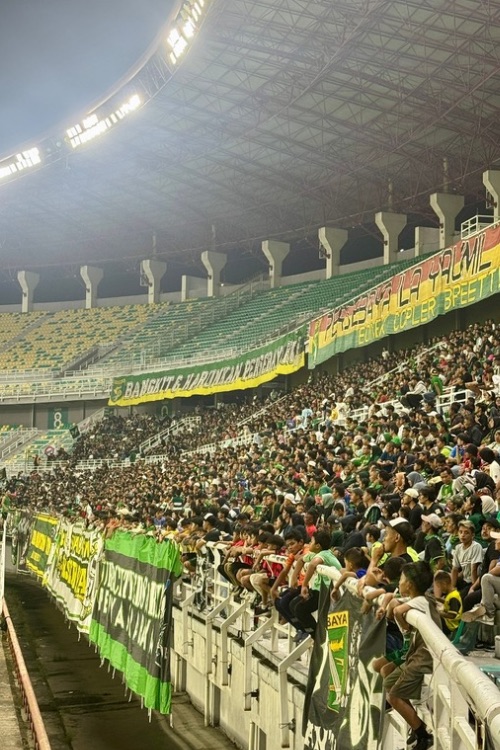
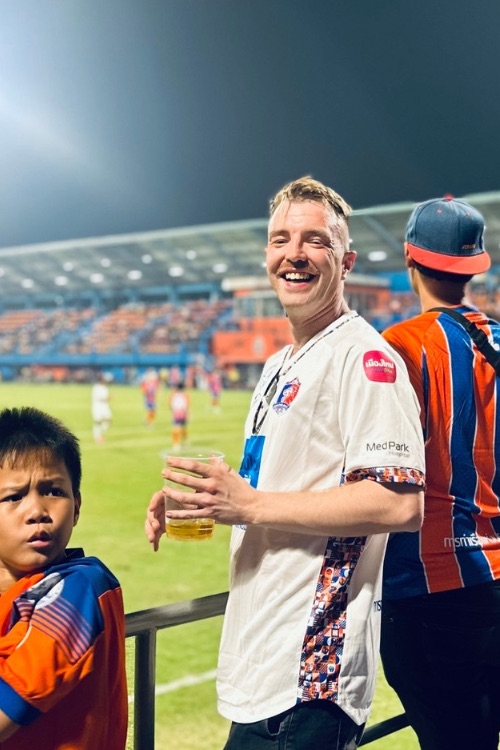
I’d lie if I’d say I plan my trips around fixtures but every time I’m in a foreign city I have this urge to attend at least one game. What stays with me is the sound, the barra bravas in Latin America singing nonstop, with a physical, almost religious intensity, Southeast Asian ultras build full choreographies in stadiums that barely fill a third of their seats and football is usually kind of bollocks. I’ve watched these scenes in places like Surabaya, Bangkok, Hanoi, Samarkand, Santiago de Chile, Arequipa and other places. Different languages, different histories but the same instinct: show up, make noise, belong.
Four World Cup games, four different football cultures
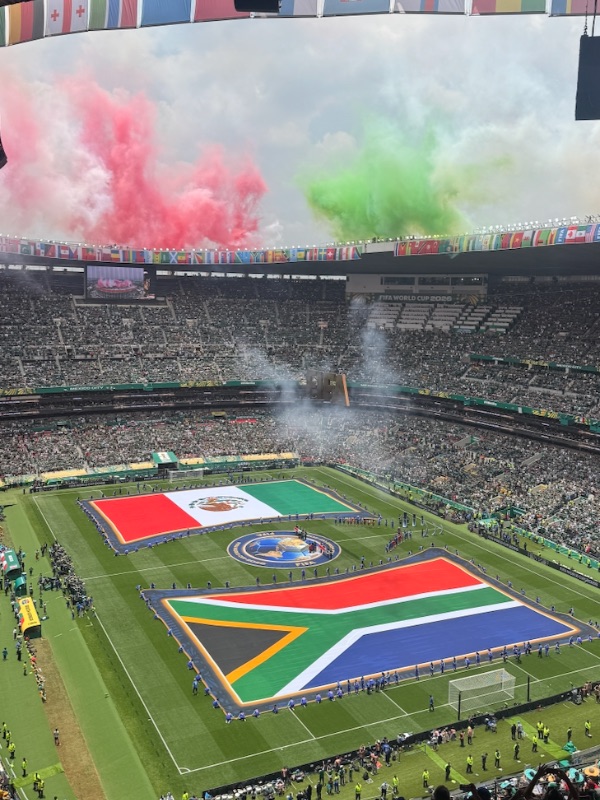
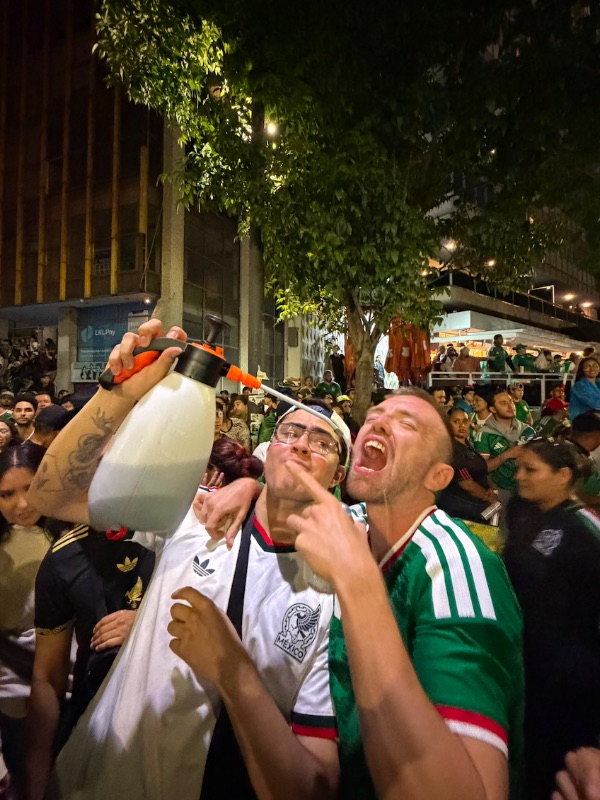
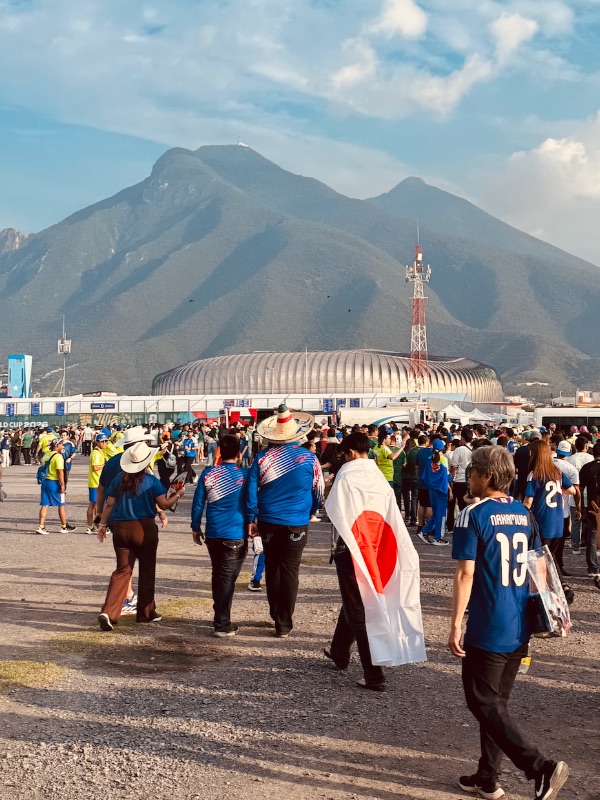
I spent three months in Mexico in the summer of 2026 and the four matches I got tickets for (a blind draw, so I didn’t choose any of them) felt like four different sports. Mexico vs South Africa at the Azteca was the opening game. In 2010 I was 15, watching the same two teams open the World Cup from my parents’ living room. Sixteen years later I was 31, in a green Mexico shirt, full of tears in my seat because a kid on a sofa had somehow ended up here. Japan vs Tunisia in Monterrey, the 1000th game in World Cup history, showed me Japanese fans cleaning up their seats while everyone else left and one of them gave me a handmade thank-you bandana. Colombia vs DR Congo in Guadalajara was a party where strangers became old friends within hours. Spain vs Uruguay was the flat one, remembered mainly for watching United’s Manuel Ugarte go down with a horrible injury. Still, the games were only half of it. The people I met made me feel like a guest rather than a tourist and when England knocked Mexico out, I was crying alongside them
The football jerseys are the new fridgemagnets
My collection runs past forty shirts and the ones I value aren’t the famous ones. The favourites are Partizan Belgrade, Persebaya, Port FC from Bangkok, FC Hanoi, AC Taipei, Yadanarbon United in Mandalay, Chivas Guadalajara, Colo-Colo and an original Macau 2019 home kit. Each is tied to a place and some memories. A big-club replica tells people you like football. A Yadanarbon United shirt tells them you were in Mandalay, Myanmar and cared enough to find the club.
Most people bring home a fridge magnet from their travels. I bring home a jersey and the difference is that a magnet sits on a fridge while a shirt gets worn. It’s also the best conversation starter I know among like-minded people, especially at music festivals, haha. Put on an FC Hanoi shirt in a field full of strangers and within ten minutes somebody will ask “wait, you’ve been to Hanoi? You actually went to a game?” Suddenly you’re swapping stories about Southeast Asian terraces with someone whose name you don’t know yet and by the end of the night you’ve got a new mate. Or when a random group of mexicans (and mexicans will really believe I’m kind of obsessed with them, jeez) came to me smiling at a festival because at one day I was wearing a Chivas Guadalajara shirt, I was laughing so hard. In Budapest, at a random music festival you ran into your favourite people and the connection is just there. No other souvenir does that.
Football is life, even when it hurts
Dani Rojas wasn’t joking and he wasn’t naive. Football is the one thing that connected a hungarian teenage ultra, a United fan who’s seen too few good days and a traveller standing among strangers around the world. These days it’s differentl, my life changed, and so did I. I rarely go to games looking for trouble anymore and I haven’t for many years. What I go looking for now is a feeling that disappeared with my teenage years: that total, unthinking belonging, where you stop being a person with problems and become one voice in a stand. For a long time I assumed it was gone for good, something that only belonged to being sixteen and angry and surrounded by mates. Then the World Cup brought it back. In a crowd of strangers from everywhere, in a language I half understood, I felt it again and I let it have its moment. I think I went to those games to close that chapter, and I think it’s closed now, for good and in peace. That’s what I took from the tournament. I didn’t find the feeling again so I could chase it forever, I found it so I could finally put it down, this part of my childhood died at the World Cup for good, but I still play for fun, still support United and still visit foreign fixtures. Football is life.