The changes in the first case study only work if the right patients actually arrive. This article follows the enquiries back to their source and asks what the clinic’s numbers were really measuring.
The first part (business development) of the case study is available here.
The third part (building an internal team) of the case study is available here.
Executive summary
The clinic’s advertising looked healthy by every standard agency measure. Leads were cheap, conversions were steady and the monthly reports showed improvement, meanwhile the calendar for high-value consultations stayed thin. The cause was structural. Campaigns were optimised for the conversions that were easiest to generate and platform metrics could not distinguish a lip filler enquiry from a rhinoplasty consultation. I audited the whole digital ecosystem, ended the agency relationship, rebuilt measurement around business value and automated the path from advertisement to booked consultation. Combined with the commercial changes described in the first case study, the high-ticket share of appointments rose from 13% to 38%.
At a glance
| Starting point | Multiple ad channels run by an external agency, with plenty of reporting and attractive lead costs |
| Core problem | Campaigns optimised for the cheapest conversion, which was the low-ticket enquiry |
| Low-ticket demand | Lip fillers, botox treatments, etc |
| High-ticket demand | Mammoplasty, rhinoplasty and similar procedures |
| What I built | Full audit, separate acquisition environments, revised tracking, Whatsapp and Telegram booking flows with calendar integration, human follow-up for high-value procedures |
| Outcome | Contributed to the programme-wide shift in high-ticket share of appointments from 13% to 38% (87:13 to 62:38); this workstream’s contribution is described in the Results section |
What I did myself and what I directed
I led the audit and built the measurement and booking architecture: the separate acquisition environments, the revised conversion tracking and the Whatsapp and Telegram booking flows with calendar integration. The clinic’s own team kept the appointment calendar current and took over each booking once it was confirmed, and medical questions in the flows were always answered by clinicians, not by the automation.
Context: plenty of data, little insight
The clinic ran several advertising channels, an external agency managed the campaigns and reporting was abundant. Campaigns generated enquiries, lead costs looked attractive and the agency could show a steady flow of conversions. On paper, nothing looked alarming. The business analysis had already shown the real issue: plenty of demand for lower-ticket treatments and a struggle to fill the calendar with consultations for higher-value procedures. The next question was whether the marketing operation contributed to that imbalance. It did and quite significantly.
The core problem: optimising for what is easiest to measure
An ad platform learns from the conversions it is told to find and it finds the cheapest ones first. A prospective patient interested in lip fillers can submit an enquiry in moments, often after a single social media advertisement. Someone considering rhinoplasty behaves very differently. They may spend weeks researching surgeons, comparing clinics, studying before-and-after results and discussing the procedure with family before they even consider a consultation. From the platform’s perspective the first person is the better conversion: cheaper, faster, easier. From the clinic’s perspective the commercial value of the two enquiries is very different. This is the most common failure I see in healthcare related performance marketing. The campaigns work exactly as instructed, the instructions are wrong.
Step 1: A full digital infrastructure audit
Before changing any campaign or introducing any tool, I needed to know what was running. I approached it as an infrastructure audit rather than an ad account review and I looked at every relevant touchpoint.
| Area | What we examined |
|---|---|
| Measurement and analytics | Google Analytics, Google Tag Manager, conversion events, attribution settings, tracking consistency and the link between website activity and actual appointments |
| Paid search | Google Ads account structure, keywords, search intent, bidding, conversion actions and the split of spend between treatment categories |
| Paid social | Meta Ads campaigns, audiences, creative performance, lead forms, retargeting and the quality of enquiries by campaign |
| Video and discovery | YouTube and TikTok activity and the role of video in awareness and consideration |
| Communication and booking | Website forms, Whatsapp, Telegram, CRM processes, appointment booking and how enquiries reached the clinic |
Checking that tracking codes exist is the easy part. The real question was whether the systems communicated and whether the data they collected could support business decisions.
Consider the funnel logic: a platform might report 100 conversions while the clinic’s own records show that only 60 people booked a consultation. Perhaps 20 of those attended, and only some were suitable candidates for the treatment they originally asked about. If measurement stops at the first conversion, everything below it stays invisible. I wanted to connect advertising spend, enquiries, booked consultations and eventual commercial outcome, which meant looking beyond the standard agency dashboard.
Step 2: The agency decision
The audit exposed a second problem: practically every campaign was optimising towards low-cost, low-ticket enquiries. This was not a question of competence, the agency was performing well against the metrics it had been given. The objectives themselves were wrong and the way the engagement had been briefed and measured never connected them to the clinic’s revenue. A lip filler campaign could easily beat a rhinoplasty campaign on cost per lead and conversion volume and the agency could report that improvement every month. Nobody was asking how much revenue the advertising actually generated. The agency defended platform-level metrics, while I was evaluating the whole business outcome. Those were two different conversations.
When I raised budget allocation and the lack of any distinction between low-ticket and high-ticket acquisition, the reporting we were given could not be tied to the clinic’s financial objectives, because it had never been designed to be. The discussion kept returning to lead costs and volumes, which were the measures the agency had been hired to improve. The gap was one of scope and incentives, not of effort. The clinic needed an arrangement in which someone was accountable for revenue as well as for leads.
We decided to end the relationship. It was an important decision, because it let us stop optimising a system that was misaligned with the clinic’s goals and start building one around the real growth objectives.
Step 3: Separate the data, separate the acquisition models
Once the problem was clear, I restructured the digital infrastructure around one principle: clean data boundaries. Previously, different treatments competed inside overlapping campaign structures, landing pages and reporting environments, so nobody could tell which activity contributed to the appointment mix we wanted.
We introduced separate environments for the two treatment categories:
- Dedicated landing pages with messaging and conversion paths tailored to each category.
- Separate social media pages and content structures for different audiences and communication strategies.
- Native landing experiences designed to match the advertising platform and remove friction.
- Separate advertising account structures for clearer campaign ownership and reporting.
- Distinct conversion events and measurement logic, so a low-ticket enquiry is never treated as equivalent to a high-ticket consultation booking.
The point was not to duplicate everything for the sake of more accounts. Someone clicking an advertisement for lip fillers should not be measured in the same way as someone booking a rhinoplasty consultation. Their motivations, decision-making processes, acquisition costs and commercial value differ.
| – | Low-ticket (lip fillers, botox) | High-ticket (mammoplasty, rhinoplasty) |
|---|---|---|
| Typical decision | Quick, often after a single social advertisement | Weeks of research, comparison and family discussion |
| Campaign objective | Efficient lead generation | Qualified consultation bookings |
| How success is judged | Cost and volume of enquiries | Consultation bookings and enquiry quality |
| Booking journey | Automated booking flow | Automated booking, then a call within one working day |
With this structure in place we could answer questions that had been impossible to untangle before. Which channel generates the most qualified high-ticket enquiries? Which landing page produces the highest consultation booking rate? How much does it cost to acquire a consultation rather than a form submission? Which investments are contributing to the clinic’s financial objectives?
It also allowed different optimisation strategies. Low-ticket campaigns could keep chasing efficient lead generation, while high-ticket campaigns were evaluated on bookings and quality. The cheapest lead was not necessarily the best lead and for the first time we could prove it with data rather than opinion.
Step 4: Two discoveries hidden in the clinic’s own data
Both findings come from aggregated and anonymised records of enquiries and bookings. No individual patient data is shown or used here.
A large Russian-speaking client base
Analysing existing customer and enquiry data showed that a significant proportion of the clinic’s clients were Russian-speaking. The previous acquisition strategy had not reflected this, even though Dubai is a particularly diverse international market. Language is more than translating an advertisement. It shapes the experience from the first search query through the sales conversation to how clearly someone understands the consultation process. For high-value procedures, trust and clarity are essential: a prospective patient needs to understand the clinic, the doctor, the process and the options. If communication feels unnatural, friction follows. We treated this group as a distinct acquisition opportunity rather than assuming one generic English-language approach would work for everyone. Sometimes the most valuable segment is already sitting in your database and nobody has looked.
Two-thirds of high-ticket bookers were men
The existing strategy targeted women, which is a natural assumption for an aesthetic clinic. A single Excel filter on consultation bookings for higher-ticket procedures showed that 66% of the people booking were men. Many were husbands, partners of any kind and other male family members arranging a consultation for someone else. The person clicking the advertisement was not necessarily the person undergoing the procedure. Marketers talk about the buyer and the end user, but audience definitions rarely account for the difference. Reaching the person who books is not the same as involving the person who decides. The advertising and the follow-up call were written to be useful to a partner or relative arranging a consultation, but the consultation itself was always with the patient and the decision to go ahead was the patient’s. This changed how we thought about targeting and messaging for higher-ticket procedures. Continuing to build campaigns around the traditional female audience would have ignored a substantial part of the real opportunity. It also needed no expensive market research project, only an Excel query and someone willing to look at the data.
Step 5: Turn advertising into an actual booking process
Once acquisition was separated and measurement improved, the next question was what happened after the click. The original journey had too much friction between expressing interest and securing an appointment We built advertising and landing page experiences connected to Whatsapp and Telegram flows, integrated with the clinic’s appointment management infrastructure. The sequence was deliberately simple:
- Advertisement interaction. A prospective patient clicks a campaign promoting a specific procedure.
- Initial communication. The patient enters the relevant Whatsapp or Telegram journey and can receive information and start an enquiry.
- Basic qualification. The system gathers what is needed to understand and route the enquiry.
- Appointment availability. The integration checks consultation capacity in the clinic’s calendar.
- Booking confirmation. The patient picks an available slot and receives confirmation.
- Internal notification. The team receives the booking so sales and clinical staff can prepare.
The calendar integration was the critical piece. There was no point generating more rhinoplasty enquiries if prospective patients could not find an available consultation. Advertising, communication tools and HCPs’ schedules had to operate as one connected system, which is why the calendar work in the first case study and the technology here were designed together. We also wanted to eliminate the familiar delay where someone submits a form and waits hours for a call-back. In a competitive aesthetic market, that gap is long enough for a prospect to contact another clinic, since usually second and third options are usually lined up for high-ticket treatment consultations. Automation handled the initial interaction and booking, while medical assessment and treatment decisions stayed with the clinical team.
Consent and data handling in the booking flows
Putting booking on Whatsapp and Telegram meant handling personal data in third-party tools, so the flows were designed to ask for as little as possible. They collected the details needed to book and route the enquiry, such as name, contact number, preferred treatment and time. They did not take medical history or give medical advice, which stayed with the clinical team at the consultation. Patients were told at the start how their details would be used and could stop at any point and speak to a person.
Step 6: Human follow-up for high-ticket enquiries
Not every enquiry should go through the same automated process. A straightforward treatment suits a convenient automated booking. A rhinoplasty candidate has questions about the procedure, recovery, suitability, expected outcomes and the surgeon’s experience, and a booking confirmation alone does not answer them. For selected high-value procedures, we added a dedicated follow-up. When someone booked a consultation, the clinic’s medical sales team was notified and the prospective patient received a phone call within one working day. The call did not replace the consultation or offer medical advice. It confirmed the booking, clarified expectations, answered administrative questions and explained what to expect next. It also let the team catch problems early. If someone had misunderstood the procedure or booked the wrong type of appointment, it could be fixed before the consultation. We stopped treating every lead as an interchangeable database entry and built communication journeys matched to the value, complexity and expectations of each service.
The results
Separating acquisition channels, improving the booking journey, introducing suitable automation and connecting advertising to the clinic’s operational capacity let us direct attention to the services that mattered commercially. The appointment mix moved from 87:13 to 62:38 in favour of high-ticket procedures, so the share of high-ticket appointments rose from 13% to 38%. That movement is the result of the whole programme, including the commercial and organisational changes in the first and third case studies.
The change did not come from one successful campaign, and we did not simply raise ad spend. It came from aligning several elements:
- Clear separation between low-ticket and high-ticket acquisition.
- Conversion tracking and reporting that reflected business value.
- A realistic picture of who was actually booking consultations.
- Whatsapp and Telegram booking automation.
- Direct integration with HCPs’ consultation availability.
- Dedicated human follow-up for selected high-value procedures.
The clinic was not only receiving different enquiries, it had much better infrastructure for handling them. This workstream’s own contribution is easier to state than to isolate. Separating the acquisition environments made it possible to measure cost per booked consultation instead of cost per lead, and to see which channels produced qualified high-ticket enquiries rather than cheap form submissions. The booking automation removed the wait for a call-back and the calendar integration meant that a prospective patient who wanted a consultation could find one. Those are the conditions that let the commercial changes in the first case study convert.
Key takeaways
- Platform metrics are not business metrics. Cost per lead can improve while the business gets worse. Always connect spend to consultations and revenue.
- Separate what you want to compare. Distinct accounts, pages and conversion events are what make questions about value answerable.
- Mine your own data first. A language segment and a gender assumption were both overturned by existing records, with no new research.
- Automate the routine, keep humans where trust is decided. Fast booking for simple treatments, personal calls for surgery.
- Align incentives with your supplier. If an agency is rewarded for platform metrics, it will optimise for platform metrics.
The platforms did exactly what they were told to do: they found inexpensive conversions. The fix was not another dashboard or a cleverer bidding strategy, the fix was rebuilding the relationship between marketing technology, customer behaviour and business economics.
The booking journey at a glance
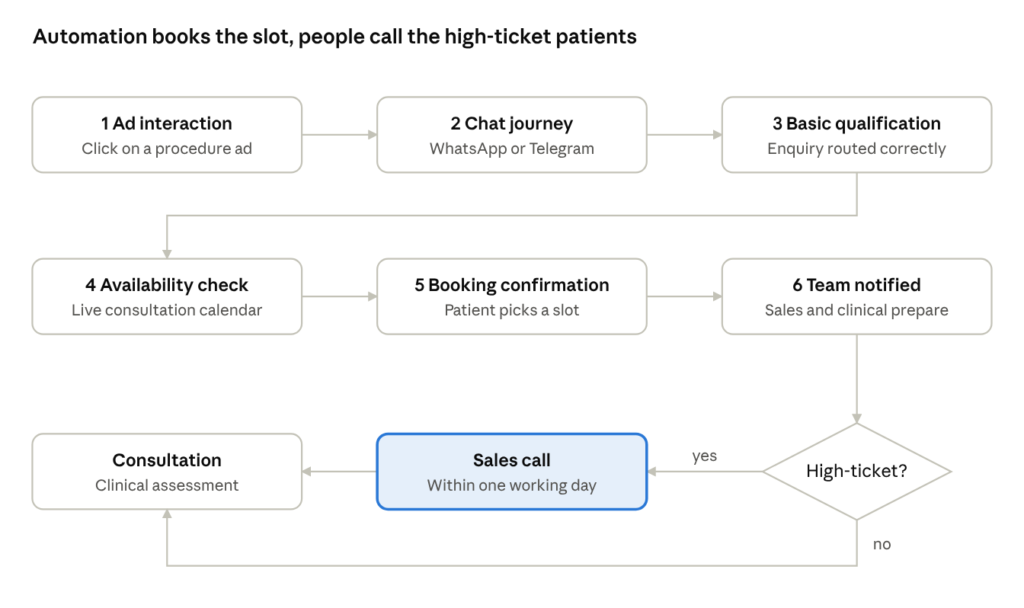
Steps 1 to 6 are the automated path from advertisement to confirmed consultation. For high-ticket procedures, the booking also triggers a personal call, so trust is built by a person at the moment it matters most.