Good systems still need people who run them every day. This article is about the people side: how I chose them, how they worked together and what it takes to lead specialists well.
The first part (business development) of the case study is available here.
The second part (marketing technology) of the case study is available here.
Executive summary
Ending the agency relationship was the easier decision. The hard question was what came next. The clinic had capable HCPs, a clearer commercial direction and rebuilt acquisition infrastructure, but the people running the marketing still sat outside the business. I designed an internal marketing department around the actual work, hired for capability and ownership rather than job titles and worked as an external CMO setting strategy, structure and standards. We recruited and developed an eight-person performance marketing and project team. Four of its members, whom I mentored directly, subsequently moved into more senior roles inside the clinic and at other organisations.
At a glance
| Starting point | Agency terminated; digital infrastructure rebuilt, but execution still sat outside the business |
| My role | External CMO, with a mandate to design the team, recruit and own marketing performance |
| What I built | An eight-person performance marketing and project team: PPC, design, video, social, content and coordination |
| People outcome | Four team members I directly mentored went on to more senior positions, internally and at other organisations |
| Business outcome | Part of the programme-wide result: high-ticket share of appointments from 13% to 38%; revenue per appointment from about AED 4,500 to AED 10,400 |
Context: the limits of outsourcing
An external agency can run campaigns, produce reports and deliver creative assets. What it cannot realistically do is own the entire marketing operation, understand the commercial consequences of every decision or build the internal knowledge needed to keep improving the business. The clinic needed more than a replacement agency, it needed its own marketing department. I was given the mandate to design and build it and I continued as external CMO, responsible for strategy, team structure, recruitment and overall performance. The people executing the work would belong to the clinic. The distinction mattered. I was not assembling freelancers who happened to report to me, I wanted a department with defined responsibilities, complementary skills and a shared sense of ownership.
The scope of my role
As external CMO I owned marketing strategy, team structure, recruitment and performance targets. I did not employ the team, the people executing the work belonged to the clinic. Medical questions went to qualified professionals and clinical content was never approved by the marketing team alone.
Designing the team around the work
I started with what the clinic had to do every day, not with what a typical marketing department looks like and certainly not with how many people an agency would assign. The work was practical: manage several paid acquisition channels, produce a steady volume of creative, understand different patient segments, maintain the clinic’s social presence, coordinate content production and keep improving the booking and follow-up process.
Those responsibilities need different skills and expecting one or two generalists to cover them would have guaranteed mediocre execution, so I structured the team around the work:
| Role | Why it existed | What I looked for |
|---|---|---|
| Two PPC specialists | Two people on paid acquisition gave capacity to test audiences, creative and campaign structures without neglecting existing activity | Understanding of conversion quality and acquisition cost and of the difference between a cheap lead and a commercially valuable consultation |
| Two graphic designers | Aesthetic medicine is highly visual and must be consistent, relevant creative matters when different procedures speak to different audiences | Comfort working within a brand system, speed in producing variations for testing, and the ability to turn a brief into an asset without five rounds of clarification |
| Video specialist | Video could not remain an occasional outsourced task, the clinic needed steady content across paid campaigns and social channels | Understanding the purpose of a video, since an ad built to generate consultations has a different job from a doctor explaining a procedure |
| Social media specialist | Social had to support acquisition and brand, not just publish posts | Knowledge of the different audiences, a steady publishing rhythm, coordination with creative and the judgement to see which topics deserve development |
| Content and coordination (2) | Medical expertise had to become clear communication, and campaigns, content and creative needed to keep moving | Enough procedural knowledge to communicate accurately and the discipline to send medical questions to qualified professionals |
Together, these capabilities formed the eight-person performance marketing and project team. Job titles mattered less than the capabilities behind them. I wanted people who were excellent at their craft but who also had something that rarely appears on a CV: the ability to think beyond the task assigned. A PPC specialist who notices a campaign attracting the wrong enquiries should not simply report it and wait. A designer should understand why a creative direction is being tested. A social media manager should explain why a topic matters to the business, not just quote an engagement rate. The department needed specialists, not people who followed briefs.
The skill that mattered most: ownership
Technical skills were relatively easy to assess. Candidates could show previous campaigns, designs, videos and channel experience, accountability was harder to test. I have worked with enough agencies and marketing departments to know how much professional energy goes into explaining why something did not work. The platform changed its algorithm, the client did not provide the materials, the landing page was weak, the budget was too small. Sometimes those explanations are valid, but they do not move the business forward on their own. I wanted a team that treated problems as something to solve rather than something to pass along. That changed the relationship between the people doing the work and the results they were responsible for:
- Underperforming campaigns. The conversation was never only about whether the PPC specialist had followed the agreed setup. We asked what happened, what the data suggested, what could change and who would take the next step.
- Creative that attracts the wrong enquiries. The answer was not automatically to adjust targeting. The message, the visual or the offer itself might be wrong. These were connected parts of one acquisition process, not separate problems for separate people.
- Challenge, including of me. I wanted people who raised concerns and proposed solutions even when that meant questioning something I had suggested. A team that simply agreed with the external CMO would have defeated the point of building an internal department.
- Honesty about failure. Not every campaign or concept would work and that was fine. Hiding poor performance behind a carefully selected metric, or repeating a mistake because nobody wanted to own it, was not.
Making specialists work as one department
Hiring capable individuals was only half the job, a group of specialists does not automatically become a functioning team. The ppc specialists needed a reliable supply of creative variations, the graphic designer and video specialist needed feedback from real campaign performance, not vague comments about what looked good. Social had to reflect the clinic’s positioning and the questions prospects were asking. Content needed access to medical expertise without turning every piece into a long approval process. So the team worked around shared priorities instead of individual channel targets. When we prioritised a particular high-ticket procedure, that decision translated into practical work across the department:
- Acquisition. The PPC specialists planned the activity and identified audiences and campaign angles worth testing.
- Creative. The designer and video specialist developed the assets those tests needed.
- Social and content. Both supported the same positioning, so every touchpoint told the same story.
- Operations. The wider operation made sure the consultation journey was ready to absorb the resulting demand.
Performance discussions became more useful as a result. Instead of separate conversations about Google Ads, Meta, social engagement and creative output, we looked at how each part contributed to a single commercial objective. I introduced clear responsibilities, regular performance reviews and a much closer link between execution and business results, so everyone knew what they owned, what success looked like and where their work fitted. As external CMO, my job was not to micromanage advertisements, approve every graphic or direct how the video specialist edited a frame. My responsibility was to set direction, establish priorities, provide context, recruit well and create conditions in which the department could perform. I wanted to spend my time asking whether we were solving the right problems and whether the team had the information it needed. The specialists knew their disciplines better than I could know every operational detail.
Developing people, not only managing them
Building a department is also a development project. I directly mentored four members of the team (ppc specialists and the social media and the video specialist), working with them on the same habits I had hired for: owning outcomes, connecting their craft to commercial results, challenging assumptions and being honest about what had not worked. All four subsequently progressed into more senior positions, one of them as performance marketing lead, one of them as creative lead inside the clinic and other two went to different organisations. I count the second group as a success as much as the first. A team that people can grow out of is a team that was worth joining and it is the strongest signal I know that a department is building capability rather than just consuming it. Based on what I learnt during their hiring process, it was a fairly easy job to find their replacements.
Results
When I first looked at the appointment mix, high-ticket procedures accounted for 13% of appointments and low-ticket treatments for the remaining 87%. After the commercial changes, the rebuilt acquisition infrastructure and the internal marketing operation took effect, the split was 38% high-ticket and 62% low-ticket, a 25-percentage-point increase. Average revenue per appointment rose from approximately AED 4,500 to AED 10,400. This was not the result of one clever advertisement, a social media strategy or a particularly talented PPC specialist. It came from changing how the business approached acquisition, connecting marketing activity to the clinic’s economics, fixing the systems behind the booking journey and putting the right people in place to run the operation.
| Outcome | Before | After |
|---|---|---|
| Appointment mix (low-ticket : high-ticket) | 87:13 | 62:38 |
| Average revenue per appointment | About AED 4,500 | AED 10,400 |
| Marketing execution | External agency | Eight-person in-house performance marketing and project team |
| People development | Not tracked in this case study | Four mentees promoted into more senior roles |
The headline result belongs to the whole programme. The marketing department’s contribution is in how efficiently the clinic could acquire high-ticket consultations and in how quickly the team could test and replace what was not working. An eight-person team is a real cost and it replaced an agency whose objectives were set around platform metrics, however it was fairly easy to fund these changes mostly from the agency’s budget and the increasing revenue. The case for it rests on ownership: the people producing campaigns belonged to the clinic and were accountable to its commercial objective, not to lead volume.
The difference between having a marketing department and owning marketing
There is a common misconception that bringing marketing in-house makes a business more efficient automatically. It does not. An internal team can be just as fragmented, reactive and disconnected from commercial reality as an external agency, and most of the times more expensive. The benefit comes from a team that accumulates knowledge about the business, works closely with the people delivering the service and has a direct stake in improving the operation. The clinic no longer had to explain itself to an agency every time priorities changed. The people producing campaigns belonged to the same organisation as the people managing consultations, so feedback moved faster and the team built on what it learned instead of treating each campaign as an isolated assignment. The department was also no longer judged by how busy it looked or how many leads it generated. Its purpose was to support the commercial direction of the clinic.
Key takeaways
- Hire for capabilities, not titles. Start with the work that has to happen every day, then build the team around it.
- Ownership is the scarce skill. Craft can be shown on a portfolio, while accountability has to be tested and then reinforced in every review.
- Run one department, not a set of channels. Shared commercial priorities beat individual channel targets.
- Lead by direction, not supervision. Set priorities and context, then let specialists decide within their expertise.
- Develop people deliberately. Mentoring turns a hiring decision into a pipeline of senior talent, wherever those people eventually work.
I was still an external CMO, but the department was no longer external. That was the whole point.
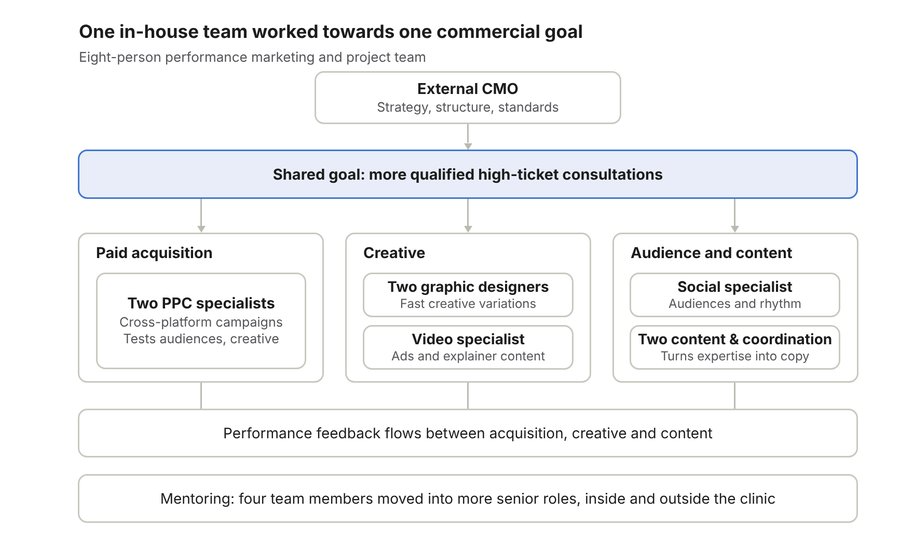
The team was organised by the work that had to happen, not by channel targets. Every group pointed at the same commercial goal, and feedback moved between them continuously.