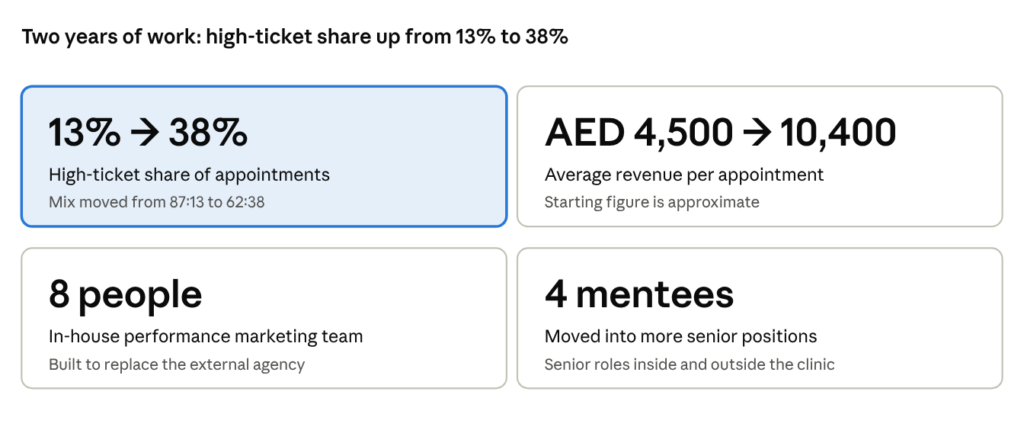
Over the last two years, first as external consultant then as operations manager and external CMO, I led the changes that took an Emirates aesthetic clinic from 13% to 38% high-ticket appointments and lifted average revenue per appointment from about AED 4,500 to AED 10,400. The series of these case studies cover the business, the technology and the people part.
The second part (marketing technology) of the case study is available here.
The third part (building an internal team) of the case study is available here.
These case studies describe one combined programme, so the headline result belongs to all three. Each one says what I owned and what the clinic’s own leadership and team owned and each describes what its own workstream contributed to the shared result. The clinic is not named and its people are referred to only by their role, since my NDA agreement does not allow this until late 2027. Client and enquiry data is reported in aggregate only, with no individual patient information and all revenue figures are rounded.
Results at a glance
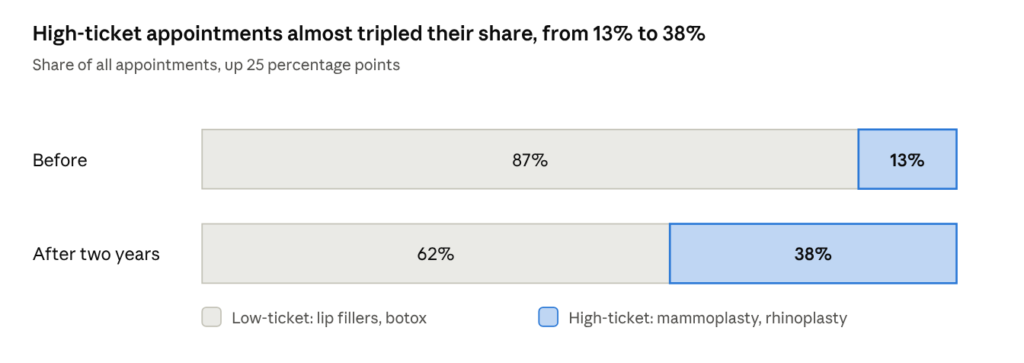
The two treatment groups behave differently, which is why the clinic’s calendar, marketing and sales all had to change.
| Low-ticket treatments | High-ticket treatments | |
|---|---|---|
| Examples | Lip fillers, botox treatments, skin boosters, laser hair removal, non surgical thread lifts | Mammoplasty, rhinoplasty and similar procedures, otoplasty, chin and jaw surgery, facelift, necklift, blepharoplasty |
| Typical decision | Quick, often after a single advertisement | Weeks of research, comparison and family discussion |
| What it needs from the clinic | Easy booking and efficient delivery | Structured consultations, protected calendar time and personal follow-up |
| Effect on the calendar | Fills slots quickly, but revenue per appointment stays low | Needs reserved consultation capacity to convert |
How the figures are defined
The figures in these case studies come from the clinic’s appointment records, comparing the start of the engagement with the end of the second year. An appointment is a booked treatment or procedure appointment, and revenue per appointment is total revenue divided by the number of appointments.
The mix and the revenue per appointment can also be checked against each other. Prices were broadly unchanged, the AED 5,900 rise in revenue per appointment (from about AED 4,500 to AED 10,400) came from a 25-point shift in the mix. That puts the difference between a high-ticket and a low-ticket appointment at about AED 23,600. The starting mix then fixes the two averages: roughly AED 25,000 for a high-ticket appointment and roughly AED 1,400 for a low-ticket one.
| Measure | Start | End |
|---|---|---|
| Low-ticket share of appointments | 87% | 62% |
| High-ticket share of appointments | 13% | 38% |
| Implied average, low-ticket appointment | About AED 1,400 | About AED 1,400 |
| Implied average, high-ticket appointment | About AED 25,000 | About AED 25,000 |
| Resulting revenue per appointment | About AED 4,500 | About AED 10,400 |
These are implied averages, not measured prices, and the calculation always balances because it is built from the same two data points. Its purpose is narrower: it shows that the whole rise in revenue per appointment can be explained by the change in mix alone, with no price increase, if average prices were broadly unchanged.
Case study 1: Rebuilding the commercial model – summary
The clinic had invested in surgeons, equipment and facilities able to deliver complex, high-value procedures, yet most of its calendar was filled with lip fillers, botox treatments, laser hair removals and other low-cost, fast decision treatments. Doctors were busy, the calendar looked full but the business was still earning far less than its capability allowed.
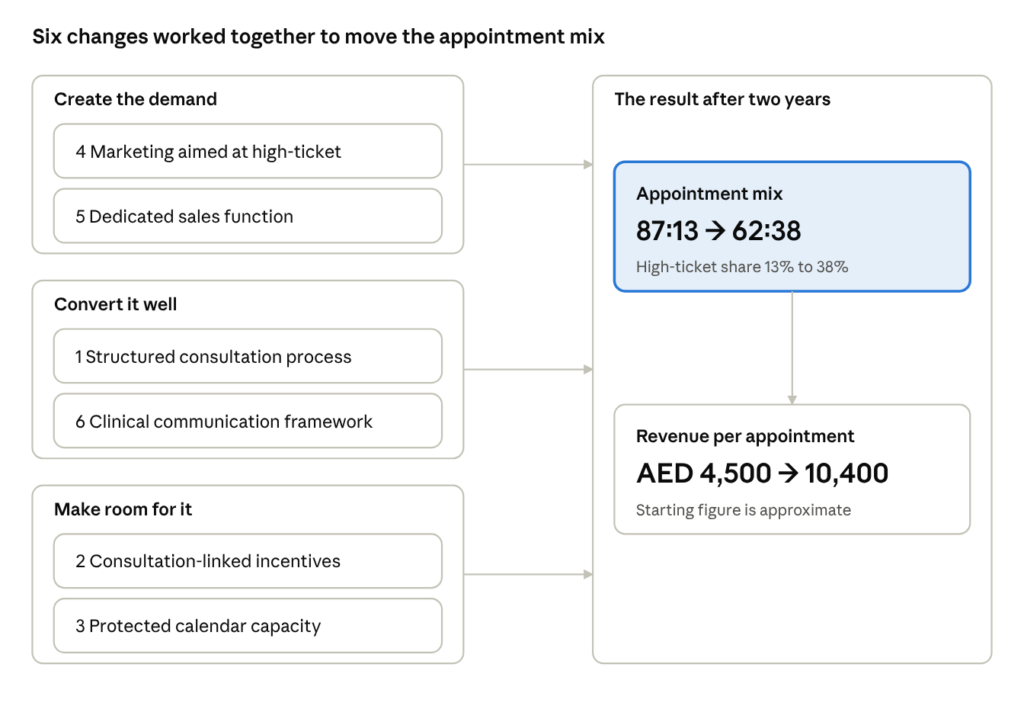
I treated it as an operating-model problem rather than a marketing one. Over two years we restructured consultations, doctor incentives, calendar capacity, marketing priorities, sales ownership and clinical communication. The share of high-ticket appointments rose from 13% to 38%, and average revenue per appointment rose from approximately AED 4,500 to AED 10,400.
Context: capability without a matching business
I met the clinic’s medical director over lunch on a tour in remote Kyrgyzstan, where we shared lunch and started to share our professions. He described a familiar pattern, even though aesthetic medicine was new territory for me. The clinic had experienced doctors, proper medical equipment and the clinical skill to perform the mentioned complex high-ticket procedures. Their calendar told a different story, the mix was heavily dominated by low-ticket treatments mentioned above. Capacity for high-value work existed, but the business was not generating, protecting or converting demand for it.
I work in business development and my specialization is private healthcare, so we agreed to test whether the problem could be fixed together. That agreement grew into a two-year engagement in which my role widened from consultant to operations manager, marketer and technical lead.
My role and what I owned
The engagement changed shape over two years and so did my so-called title. It began as a consulting arrangement, however as the work widened I took over the day-to-day running of operations and later acted as external CMO, with a mandate to design the marketing team, hire it and own its performance. Throughout I was an external advisor with no clinical authority, medical decisions and the sign-off on clinical content, stayed with the medical director and the HCPs. Because the results came from a combined programme, it is worth being exact about who did what.
| Workstream | What I did | What the clinic owned |
|---|---|---|
| Consultation process | Designed the consultation sequence and the training around it | The medical director and HCPs set the clinical content and signed it off, HCPs delivered it |
| HCP incentives | Modelled the scheme and proposed the structure | Clinic leadership approved and funded it and set the eligibility rules |
| Calendar rules | Proposed the capacity rules and made the case to the clinical team | The medical director decided the rules and enforced them with the HCPs |
| Marketing priorities and technology | Audited the digital estate and re-designed the tracking, landing pages and booking flows (case study 2) | The clinic provided system access and the live appointment calendar, and ran the resulting bookings |
| Sales function | Defined the roles, processes and targets and recruited the team | The clinic employed the team and managed it day to day |
| Clinical communication framework | Wrote the framework and ran the sessions with HCPs | HCPs adopted it; the medical director owned clinical sign-off |
| In-house marketing department | Designed the structure, hired and set standards as external CMO (case study 3) | The clinic employed the team and approved the budget |
I did not run a controlled experiment, so I cannot give an exact split of the result between the six changes. My own reading is that they worked as a system. Protected calendar capacity and a structured consultation had to exist before more high-value demand was worth generating and the sales function and the booking automation were what turned that demand into booked consultations. None of the changes would have moved the mix on its own.
The challenge
A clinic like this is exposed to a quiet commercial trap. Low-ticket treatments are easy to promote, quick to decide on and simple to deliver, so they fill the calendar first. Every filled slot feels like progress, yet each one can displace an hour that a more valuable procedure needs. High-ticket procedures behave differently. A rhinoplasty or mammoplasty candidate researches surgeons, compares results, discusses the decision with family and often needs one or more consultations before committing. Converting that demand requires time, structure and trust, none of which the clinic’s day-to-day routine was designed to provide. The question was therefore not how to get more appointments. It was how to change the composition of the appointments the clinic already had.
Starting with the economics
I did not begin with an advertising budget, a new website or another round of social campaigns. We first built a model covering customer acquisition cost, average appointment value, conversion rates, branding requirements, operating expenses and the extra technical infrastructure a different acquisition model would need. The modelling produced a useful and slightly surprising result. We did not need to reinvent the clinic or double the marketing investment. Moving just five percentage points of the appointment mix towards higher-ticket procedures would have a disproportionate effect on revenue, because a high-ticket appointment is worth far more than a low-ticket one.
That became the working hypothesis. A small, deliberate shift in mix would beat a large increase in volume. It also gave the clinical team a concrete and modest target instead of an abstract demand to sell more. The arithmetic behind that target is straightforward. Using the implied averages described at the start, every percentage point of mix moves revenue per appointment by about AED 236. Five points is therefore worth roughly AED 1,180 per appointment, about 26% on a base of AED 4,500, without a single extra appointment or a single price change. Five points was a deliberately modest target: small enough to approve without a large budget, and modest enough that HCPs were not being asked to change who they were. It was the threshold for justifying the project, not a forecast of where the mix would end up.
Diagnosis: why the mix would not move on its own
Before designing solutions, I mapped why a clinic with the right capability kept producing the wrong mix. Six structural causes emerged, and each one reinforced the others.
- Consultations were medical, not commercial. HCPs explained procedures competently, but there was no structure for exploring expectations, answering concerns, framing suitable options and agreeing next steps. Outcomes depended on each doctor’s personal style.
- The incentives pointed the wrong way. A doctor was paid for an hour spent on a lip procedure. The same hour spent consulting several prospective rhinoplasty patients earned nothing extra. Rational people followed the pay.
- The calendar was consumed by routine work. Even when marketing generated interest in surgery, the clinic lacked the capacity to handle those enquiries properly. They were creating demand the business was not organised to accommodate.
- Marketing favoured the easy sale. Content and ad budget flowed to the treatments that were simplest to promote, which kept refilling the calendar with the same low-ticket work.
- Nobody owned the journey from enquiry to consultation. Marketing generated enquiries, reception handled messages and HCPs held consultations, but no person or team was accountable for the whole path between them.
- Clinical communication was unrepeatable. Cross-selling and treatment planning happened only when an individual doctor happened to be a natural communicator.
The diagnosis matters as much as the fix. Every one of these causes was invisible in the clinic’s headline numbers, because a full calendar and busy HCPs looked like success.
The interventions
We did not run six separate projects. Each change was designed to remove a constraint that would have blunted the others and the order mattered.
1. A structured consultation process
A good consultation combines clinical expertise with an understanding of the patient’s motivation, concerns and expectations. It establishes whether a procedure is appropriate, lays out the realistic options and gives the patient a clear path forward. We standardised that sequence so quality no longer depended on an individual doctor’s communication style. This was never about turning HCPs into aggressive salespeople, the aim was to make sure that a patient who left the room understood their options and the next step and that the clinic could repeat that experience reliably.
2. Incentives aligned with the clinic’s priorities
The operational insight here was simple: people do what the compensation structure rewards. A doctor who spent an hour on a lip procedure was paid for it, while an hour of consultations with prospective surgical patients generated no immediate income. The existing structure quietly steered HCPs away from the work the clinic needed most. We introduced consultation-related incentives, HCPs who completed a defined number of successful consultations per month became eligible for additional financial rewards. Clinical judgement stayed untouched and nobody was rewarded for recommending a procedure, only for conducting the consultation. This also forced a capacity conversation. We could not ask HCPs to give more time to consultations while leaving their existing schedules untouched.
3. Calendar management as a strategic lever
The appointment calendar was the physical constraint behind everything else. With routine treatments consuming every slot, any rhinoplasty enquiry generated by marketing met a diary with no room for it. We reviewed how appointments were allocated and introduced deliberate rules: protected consultation capacity, dedicated time for prospective high-value procedures and a limit on how far routine treatments could consume the schedule. It sounds straightforward, but it meant changing established habits and explaining to the clinical team why utilisation cannot be measured by counting occupied slots. A full calendar is not necessarily a productive calendar.
4. Marketing aimed at a different kind of demand
Once the operation could absorb high-value enquiries, we changed what marketing pursued. Content production and advertising moved towards higher-ticket procedures, with budget shifted to the services we wanted to grow. The messaging also had to change. Someone enquiring about rhinoplasty has a different research phase, different financial considerations and a much longer decision time than someone considering lip fillers. A campaign built for the quick decision would have attracted the wrong people and disappointed the right ones. The technical side of this work is covered in the second case study.
5. A dedicated sales function
The largest organisational gap was ownership. Between an initial enquiry and a consultation, nobody was accountable for the patient. Prospects could simply disappear after their first message. Rather than load another responsibility onto existing staff, we built a commercial function: a Head of Sales supported by two sales representatives handling phone calls and chat enquiries. Their remit included understanding the procedures, qualifying enquiries, managing expectations, following up and coordinating consultations. We defined the processes, responsibilities and performance expectations from the start, so the team had something to be measured against.
6. A repeatable clinical communication framework
Building a sales team was only half the equation, because HCPs still carry the conversion conversation. We developed a framework to help clinicians understand patient expectations, identify suitable treatment opportunities, explain benefits and limits, handle concerns and set clear next steps. It included appropriate cross-selling and upselling: if a patient arrived with one concern, the doctor needed to recognise when another treatment could genuinely complement it, however clinical suitability remained the deciding factor throughout. The goal was to make sure patients understood the full range of appropriate options, instead of every conversation being limited to whatever they first asked about. Safeguards sat alongside this: a recommendation had to be clinically indicated and recorded in the patient’s notes, the patient could decline without consequence and no doctor was rewarded for any particular recommendation. These guardrails are set out in more detail below.
Timeline: how the two years unfolded
We did not run the six changes at once and the order mattered. Capacity and consultation structure came first, because there was no point generating high-value demand the clinic could not handle. The stages below overlapped, but each one removed a constraint for the next.
| Stage | What happened |
|---|---|
| 1. Diagnosis and economics | Mapped the six causes, built the economic model and agreed the target with the medical director and clinic leadership |
| 2. Capacity and consultation | Introduced protected consultation capacity, the structured consultation process and the doctor incentive scheme, so the clinic could absorb high-value demand before more was generated |
| 3. Sales function and marketing technology | Recruited the Head of Sales and two representatives, audited the digital infrastructure, ended the agency relationship and rebuilt tracking and booking flows |
| 4. In-house marketing and scaling | Built the eight-person marketing team, moved budget towards high-ticket procedures and reviewed performance against the combined objective |
Guardrails: clinical ethics and regulation
A clinic that links doctor pay to consultations, trains clinicians to recommend complementary treatments and puts a sales team in front of surgery is working in a part of healthcare where commercial design can easily turn into pressure. The guardrails were as much a part of the model as the incentives.
- Incentives rewarded consultations, never procedures sold. No HCP earned more for recommending or performing a particular procedure. The incentive depended on completing consultations to the agreed standard and a recommendation not to operate was a fully valid outcome.
- Clinical decisions stayed with the doctor. The sales team handled information, scheduling and expectations. Questions about suitability, risk or results went to the treating doctor, and the sales and chat teams gave no medical advice.
- Patients could say no and take their time. Consultations ended with options and a clear next step, not a deadline and the patient could decline without consequence.
- The decision belonged to the patient. Advertising and follow-up were written to be useful to a partner or relative arranging an appointment, but the consultation was always with the patient and the decision to go ahead was theirs alone.
- Advertising was checked against the rules. Advertising and social content for procedures was reviewed against the applicable healthcare advertising rules in the United Arab Emirates before publication, including how results and claims were presented.
- Patient data was handled with care. Booking flows collected only what was needed to understand and route an enquiry, medical assessment stayed with the clinical team, and patients were told how their details would be used. Handling followed UAE data-protection requirements.
These rules have a cost: some enquiries convert more slowly and some consultations end with a recommendation not to proceed. I regard that as the right trade in this field. It is also what made the commercial result sustainable, because a mix built on pressured sales would not survive complaints, regulator attention or damage to the clinic’s reputation.
Results
Over two years the distribution between low-ticket and high-ticket appointments moved from 87:13 to 62:38. High-ticket share rose from 13% to 38%, a 25-percentage-point shift that almost tripled its proportion of the mix. In practical terms, out of every 100 appointments, high-ticket procedures went from about 13 to about 38. Average revenue per appointment rose from approximately AED 4,500 to AED 10,400. That change came without rebuilding the clinic’s medical capability and without simply spending more on advertising. We changed the composition of the work, and the economics followed.
Beyond the mix: what it means for revenue
A better mix is only good news if the business is better off in absolute terms. Mix can improve for the wrong reason: if routine slots are capped and low-ticket volume falls, the high-ticket share rises even when nothing else has improved. The calendar rules described above did limit how far routine treatments could consume the schedule, so the ratio alone is not enough. The simplest test uses only the two figures above. Revenue per appointment rose by about AED 5,900, or roughly 131%. Total revenue would therefore only have ended lower than at the start if the number of appointments had fallen by more than about 57%. The calendar rules limited routine work, they did not remove it: low-ticket treatments still make up 62% of appointments, so the clinic kept its volume business while adding the high-value one.
The programme was not free. It added a marketing team of eight people in place of the agency, a sales function of three and a doctor incentive scheme and it ran alongside the cost of rebuilding the booking infrastructure. Total revenue, margin and cost figures are commercially sensitive for the clinic and are not published here.
Why the result was five times the target
The model asked for five points and the clinic gained twenty-five. A gap that size needs explaining, because a target missed by that margin says something about the model. The five-point case was cautious by design. In practice the changes reinforced each other: once consultation capacity was protected, marketing could pursue higher-value demand, the sales function could convert it and the booking automation could route it, so the effects compounded instead of simply adding up. The fair reading is that the model was a floor that justified the project, not a forecast, and the combined system moved much further than the cautious case allowed for. The more important result was structural. The clinic now had a consultation process, an incentive system, protected calendar capacity, a sales function and a communication framework that worked together. None of them depended on one talented individual.
What was hard, and what I would change
The programme did not run in a straight line and the hard parts are as useful as the results.
Resistance from the clinical team
The calendar rules were the hardest change. They asked HCPs to give up slots that were easy to fill with routine work, in exchange for consultations that might or might not convert and the clinic’s usual measure of a good day, a full calendar, pointed the other way. It took repeated conversations to move the team from counting occupied slots to looking at the value of what filled them. The incentive scheme was the other half of the argument, because it meant the time was no longer unpaid.
What I would do differently
- Fix the baseline first. I would agree the starting position for total revenue, volume and cost in the first month and report against it monthly, so that the commercial case never rests on a ratio.
- Involve HCPs earlier. I would bring a small group of HCPs into the design of the incentive scheme and the consultation process from the start, instead of presenting finished rules.
- Write the guardrails down at the beginning. I would set out the clinical and regulatory standard as a written document in week one, so every campaign, script and incentive rule is reviewed against it from the start.
Key takeaways
- Model the economics before you spend. A five-point shift in mix was a far better target than a doubled budget, and it made the whole project proportionate.
- Busy is not productive. Calendar utilisation measured by occupied slots rewards the cheapest work. Measure it by the value of what fills the slots.
- Incentives beat instructions. If the pay structure rewards the wrong behaviour, no amount of persuasion will change it.
- Own the journey. Somebody has to be accountable for everything between the first enquiry and the consultation.
- Treat the business as a connected system. Marketing could not fix a weak consultation, and a good doctor could not sell consultations that never reached the diary. Companies often treat symptoms, while the underlying operating model stays unexamined.
- Check the ratio against the P&L. A better mix is only a result if total revenue and contribution rise with it. Report volume, revenue and cost next to the mix from the first month.
- Build the guardrails into the model. In healthcare, incentives, scripts and advertising need written limits before they need results.
In this clinic the HCPs were never the problem. Their capability was already there; we built a business around it that made better use of it.